
The challenge
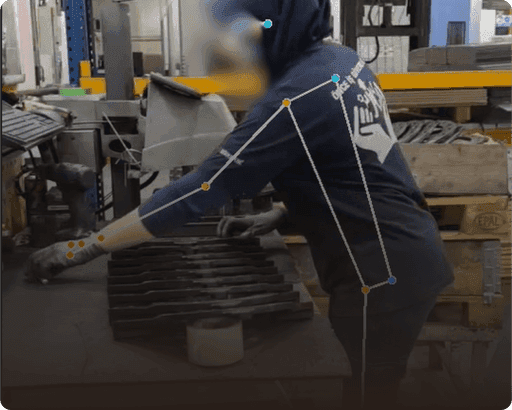
Ege Fren manufactures braking systems for the European automotive market. The final inspection and packaging cells on their main line required operators to rotate brake assemblies by hand, apply identification labels, and box the finished units into outbound pallets.
The cycle time was tight. The motions were repetitive. And the postural exposure was building up across shifts in a way that was hard to see in any single observation.
Their EHS team had run periodic manual REBA assessments, but the cadence was too slow to keep up with line changes.
What we did
ErgoRisk replaced the periodic manual assessments with a continuous program. A short video of each station was uploaded weekly, and the platform returned RULA scores for the upper-body work, NIOSH lifting indices for the box handling, and APLE traffic-light scoring for the time-series exposure.
Three changes came out of the first three months of assessments:
- Redesigned the inspection fixture so the brake assembly arrived at a height that kept the wrist neutral for the dominant rotation motion.
- Replaced a manual carry-and-place step with a short powered conveyor, removing a NIOSH lifting index above 1.5 from the loop entirely.
- Re-balanced the cell so operators rotated through three positions per shift rather than staying at a single station, spreading exposure.
Each change was tracked in ErgoRisk's action board with a responsible owner and a re-assessment date.
Results
After twelve months:
- 31% reduction in self-reported MSK complaints from operators on the inspection and packaging cells.
- Measured drop in NIOSH lifting index for the previously flagged step from above 1.5 to under 1.0.
- The EHS team moved from a quarterly assessment cadence to weekly, with the total time spent on assessments lower than before.
The change was less about any single intervention and more about being able to see the trend. We caught two regressions early because the weekly assessments were already running.
— Operations Director, Ege Fren