Software
Ergonomic risk assessment software
Score REBA, RULA, NIOSH and five more methods from a phone video, across every station and every shift, without wearables or a consultant visit.
What this software replaces
Most teams assess ergonomic risk one of three ways, and each one runs out of road.
A qualified ergonomist, scoring by hand
The most trusted answer, and the slowest. Roughly an hour per task once you include observation, joint angles and scoring. A plant with two hundred stations across three shifts cannot be covered this way, so most stations are never assessed at all.
Wearable sensors
Accurate and continuous, but every worker you want to measure needs hardware, fitting and consent. The equipment cost and the setup time mean it is used for studies, not for routine coverage.
A checklist module inside a generic EHS platform
Cheap and easy to roll out, but it records someone's opinion of a posture. It does not measure a joint angle, so the score is only as good as the person filling the form.
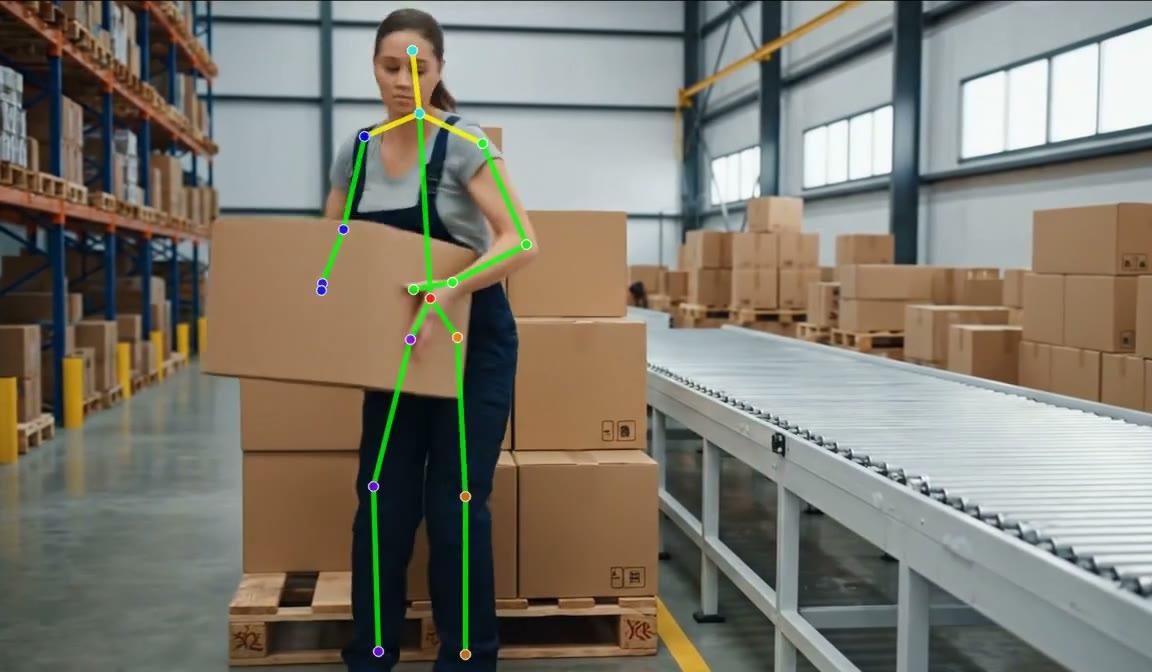
Video based assessment sits between them. You record a task on a phone you already own, and software derives the joint angles and exposure inputs that the standard methods need.
The four approaches side by side
| Ergonomist by hand | Wearable sensors | EHS checklist | ErgoRisk | |
|---|---|---|---|---|
| Measures real joint angles | Yes | Yes | No | Yes |
| Reports the standard method score | Yes | Varies | Varies | Yes |
| Hardware per worker | No | Yes | No | No |
| Time per task | About an hour | Fitting plus session | Minutes | Under 5 min |
| Realistic to run on every station | No | No | Yes | Yes |
| Continuous across a full shift | No | Yes | No | No |
| Tells you what to change | Yes | No | No | Yes |
Wearables win the row we lose: if you need a full shift measured continuously, sensors are the tool, not video.
What to look for when you compare
Six questions separate tools that produce a number from tools that hold up in an audit.
- 01
Does it run the methods your auditors already accept?
A proprietary risk score means nothing to a works council or a labour inspector. Ask which validated methods are implemented and whether the output is the standard score or a vendor invention. ErgoRisk runs REBA, RULA, ROSA, NIOSH, QEC, APLE, KIM-LHC and a configurable checklist, and reports the standard score for each.
- 02
What does it need to capture data?
Hardware per worker is the thing that quietly kills coverage. ErgoRisk needs a phone video. No wearables, no goniometers, no markers on the body, no site visit.
- 03
How long does one assessment take?
This decides whether you can repeat it. Manual scoring is about an hour per task. With ErgoRisk the median assessment finishes in under three minutes and most are done inside five, so reassessing a station after a change is a routine step rather than a project.
- 04
Does it tell you what to fix, or only that something is wrong?
A score tells you a station is risky. It does not tell you to raise the bench by fifteen centimetres. ErgoRisk returns a prioritised list of concrete changes for each finding, with the before and after context.
- 05
Can you prove improvement later?
A one off audit is a document. A programme is a loop. Look for owners, target dates and reassessment in the same system, so you can show a score that actually moved.
- 06
What comes out at the end?
Ask to see the export. ErgoRisk produces a full PDF per assessment with the method tables, the body heatmap and the scores, in English, Turkish or French, and keeps every assessment on record, so you can show an inspector how a risk was evaluated and what was done about it.
What comes out
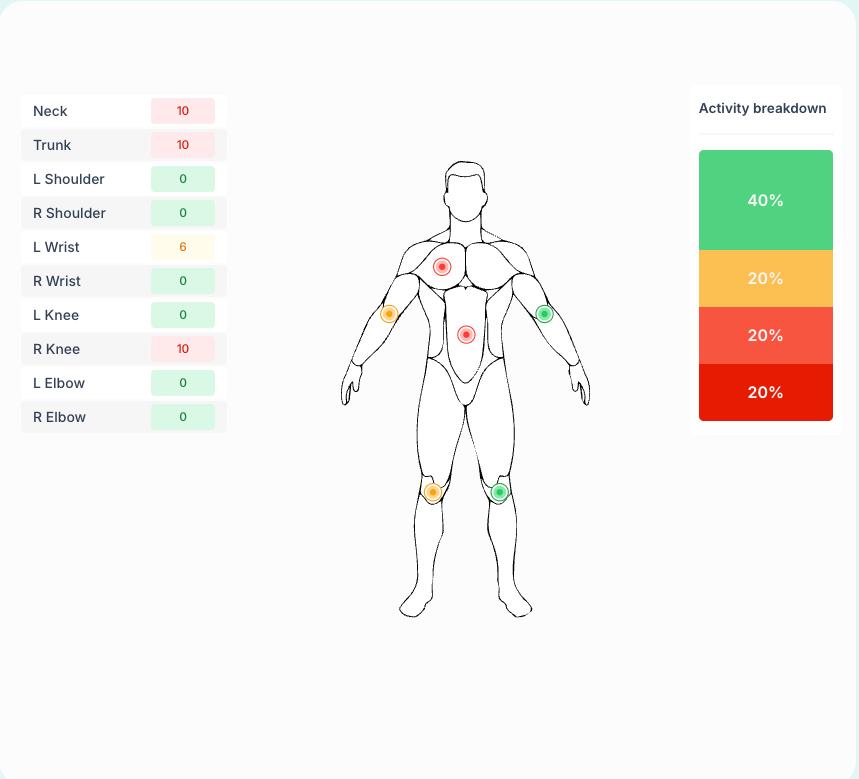
Every assessment returns a score per body region on a heatmap, so the conversation moves from "this job is hard" to "the trunk and the neck are the problem, and here is the fix".
Where ErgoRisk fits, and where it does not
It fits when the risk is physical and visible: lifting, reaching, bending, repetition, awkward sustained postures at a workstation.
It is not the right tool for psychosocial or organisational risk, and it is not live monitoring. You record a representative task, you do not stream a shift.
Being clear about that saves everyone a meeting.
Used in production, not in a pilot
Hugo Boss, Beyçelik Gestamp, Ege Fren, Gates, Lesaffre and Stackpole use ErgoRisk on real production lines.
Common questions
- Is this a replacement for our ergonomist?
- No. It removes the hours of manual scoring so the expert spends time on the fixes, and it covers the stations that were never going to get an expert visit.
- How accurate is it against a manual assessment?
- It applies the same published method to the same posture. The input is derived from video instead of measured by hand, and the output is the standard score, so it can be checked against a manual scoring of the same clip. Bring one in the demo.
- Do we pay per user?
- No. Pricing is based on the number of analyses you run, and you can invite as many colleagues as you like.
- Where is our data stored?
- In the EU.
See it score your own task
Bring a one minute video of a real job. In a 30 minute call we run it, show the scores method by method, and walk through the action plan.